Ap01 Intd. · Introductions #01

Is there such a phenomena possible in the experience of the human consciousness, that it may be said to represent a; Recipe for the Universe , or a Theory of Everything? This is the main theme and subject of this File. In this Document is found an Introductory Lecture on the Progression of Physics in the 20th Century--Primarily the New Physics--and the Relationship of the Observer--his Consciousness--to the Discoveries and Findings Representing the Paradigm of the Physicists World View in the Onset of the 21st Century.
The reader may ask, What is a Theory of Everything? An attempt at presenting a simplistic answer will be made here: A Grand Unified Theory/Complete Unified Theory in Theoretical Physics that includes the Observer is a Theory of Everything. Such a Theory will not only show that the four forces of the Universe have the same origin, but will explain the fundaments of Life and Consciousness of the Human Brain . Since there is only one Universe we are observing, then there can only be one such Theory of Everything . Only one solution can produces the Fundamental Reality Program for the Human Brain. This suggests that the Theory of Everything is the most important information, or knowledge, Man can ever achieve.
Ap02 Intd. · Introductio ns # 02
The Apocalyptic Files are an initiation and introduction to the questions and suggestions for the only possible solution involved in the formulation of the Theory of Everything. The Files suggest that the solution will have to be based on Kurt Gödel's 1931 Mathematical Incompleteness Theorem and Roger Sperrys 1981 Human Brains Functional Programs, plus the Standard Model of Theoretical Physics. Purpose of these Files is to show that the work of these men proves that the current methods used by Physicists and Neurologists, cannot alone solve the Ultimate Mystery of the Universe, Life and the Human Brain .

From the time the British physicist, Sir Ernest Rutherford, 1st Baron Rutherford of Nelson and Cambridge (1871-1937), began the bombarding of matter with Alpha particles--to investigate its inner structure--theoretical and experimental physics have been developing this method into ever larger and more sophisticated machines, now known as accelerators.
To-day, the accelerators are the biggest machines Man constructs, the most expensive machines Man builds and create the highest energies Man is capable of. In this they are in reality asking the biggest and most profound question Man can ask of Nature, as they are
Ap03 Intd. · Introductions #03
making images of the smallest things Man can discern. The huge accelerators are in essence nothing but a form of microscope. The most powerful microscopes Man can buildthe electronic microscopesare limited to looking at things that are smaller than the width of one wave-phase of an electron. It can only resolve images of structures that are larger than the length of the waves of of electron-quanta that are reflecting of them. With smaller objects the waves is not refelcted and pass around it, which means that no image is received at the microscope. The ingenious method employed in the accelerators is the acceleration of mass/energy to speeds close to the speed of light, and then this mass/energy is directed to hit a target, or shot into a beam going in the opposite direction.of electron-quanta that are reflecting of them. With smaller objects the waves is not refelcted and pass around it, which means that no image is received at the microscope. The ingenious method employed in the accelerators is the acceleration of mass/energy to speeds close to the speed of light, and then this mass/energy is directed to hit a target, or shot into a beam going in the opposite direction. In such experiments one of the beams may be composed of antimatter. The collision usually takes place in hydrogen plasma, situated in so-called accelerator bubble chambers. It is there that pictures are taken of the particle tracks created by the ensuing disintegration and these then analyzed with a mathematical theory. However, in this process nothing is seen anywhere, only the tracks left by the particles are seen in the plasma, which are then analyzed with the theories of mathematical physics.
Ap04 Intd. · Introductions #04
The results of this is that physicists find themselves moving towards the discovery of natures first law which is variably referred to as, The Unified Field Equation , (UFE), or The Grand Unified Theory , (GUT), or The Complete Unified Theory (CUT), depending on its scope. Whereas the UFE would be a mathematical unification of the four forces of nature, then the GUT unification is without gravity, in a mathematical theory (possibly also experimentally). The CUT would mean theoretical unification of all four forces (not experimentally), along with the unification of the two great theories of our times: The Quantum Theory and the Theory of Relativity. An ultimate theoretical construction would be achieved by the inclusion of explanations for Life itself in a CU-Theory. This would constitute a paradigm known as the Theory of Everything , of which a compulsory part would be inclusion of Life and the Observers Consciousness . However, this search has not been able to come up with anything that resembles a connection to either the phenomenon of life, or consciousness, but it is precisely this subject that these Files are engaged in scrutinizing.
Philosophical search has to be implemented with experiments which are now amongst the most important, challenging and exciting in all of the sciences and history of science. Our survival, and probably of all life on this planet, depends on a more complete understanding of the human brain.
For commentary, contact . peace@peace-files.org
Professor Gerald D. Fischbach
Ap05 P-I · Part #1 #05

The next 32 Pages (05-37) contain 12 General Descriptions of the Progression of Theoretical Physics, Reductionism and Quantum Mechanics, and the Failure to Include the Observer in the Analyses of Ultimate Reality, the Theories of Everything . This is a Part of the Introduction of the newly published book: THE LITTLE SCROLL , which presents such a Theory that includes Life and Consciousness of the Observer.
Note; Parts writings from: Johann Grolle, F. David Peat, Richard Restac, Stephen Hawking, John Boslough and others.
Ap06 P-I · Part #1. #06
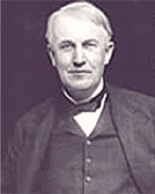
Thomas A. Edison 1847-1931
The Great Search
Years after Thomas Alva Edison discovered the light bulb, he was asked about this experience. His reply; "I was just like a little boy walking on the beach where I saw a stone which seemed different from the rest. I picked up the stone and saw why it was so." (A metaphor also credited to Newton).
During the former age of information in the history of man--the age of enlightenment in the West--the Greek age of antiquity's period of philosophy, science and art, which lasted for about 800 years, or from about 400 before, until about 400 after Christ, the famous Agora at the root of the Acropolis, became one of the prime arena in Man's discussion on the nature
of the World, Man and Reality. The philosophers of the time, which ever they were, Stoics, Pythagoreans, Epicureans or Platonists, discussed and scrutinized all subjects and left no stones ununtouched. At the onset of the dark period in the history of the spirit of Man in the West--the middle ages which began at the burning of Hypothesa's library in Alexandria about 400 years after Christ--Men began telling each other which stones were permitted to be scrutinized and which not. This control on the search for knowledge had most of its roots in religion. The period lasted for about 1200 years, during which it not only Men were condemned but also much of the scrutiny of Nature, if it did not have to do with the attempts at making gold. In this Galileo and Bruno became the most famous examples.
Ap07 P-I · Part #1. #07
In the beginning of the renaissance around the end of the 15th century, the British philosopher and nature scientist Sir Francis Bacon made the following comment "There are two revelations in reality; The first is given to us in scripture and tradition, and it guided our thinking for centuries. The second revelation is given by the Universe, and that book we are just beginning to read." This prognosis of Bacon turned out to be true and the spirit of the philosophers was reborn in the form of natural-philosophers which later evolved into the different disciplines of the natural sciences. Disciplines which have, for the last 400 years, been progressing away from each other. The motto of the sciences soon became; "Nullius in Verba," or, words alone are not enough. This in turn brought about the doctrines of empiricism and positivism, or the demand that the statement of the investigator be proven through predictions which later would appear as facts in experiments. This has now been the guiding light of the sciences for the last four hundred years and has justified itself in most fields as concerns the investigation into the nature of Nature. The method has particularily proven itself in the so called reductionistic method, which proposes to seek the nature of everting by tearing it into ever smaller fractions for analyses. However, this motto has on the other hand, brought about a new type of limitation into the investigation of nature and a decision as to what stones may be scrutinized. Now, in the later part of the twentieth century, it has come to pass that some of the special disciplines of the sciences have begun to approach each other, and even unify. This, however, is not coming about through some ideology of the scientists, rather the
Ap08 P-I · Part #1. #08
nature of the evolution of the investigation. This in turn has brought about critic and reassessment of the methods of the sciences--amongst the scientists them selves--this to the traditional methods of investigation and their limitations. The prime targets of this critic have been the phenomena that appear in the high energy accelerators of theoretical-experimental physics, where Man has sought the fundaments for the nature of reality itself.
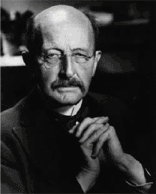
Max K E L Planck 1858-1947
At the onset of the 20th century, on the 14th of December 1900, on the birthday of The New Physics , Max Plank presented the findings of his investigation into the ultraviolet radiation and solved the enigma of the so called ultra-violet catastrophe. At this time it was generally assumed that physics could explain every thing, which lead to the closure of the Kaiserliche Patentoffice in Berlin and the Royal Academys consideration for closing it self down. The reasons; nothing more would be discovered since the causes for everything were known. There was only one thing that seemed to throw a shadow on the deterministic sciences, but this was the fact that ultraviolet radiation violated the known laws of nature--all of
which were believed to be known. Plank's findings that energy came in individual units (quanta) destroyed this believe of Man.)
With the evolution of The New Physics , Man now acquired two classes of Physical Laws, instead of one. -- Forty-five years after this beginning, this lead to the detonation of the Pluton-
Ap09 P-I · Part #1. #09
ium bomb in Alamogordo in New Mexico and thereby the onset of The Age of the Atom. The story of the evolution of the New Physics, quantum physics, is a story of a discipline which tells us that the material part of the Universe, even Space itself, are composed of matter/energy units whose smallest division is one quanta. This story is seen by many as the most magnificent part of the evolutionary history of Man's search for knowledge and understanding.
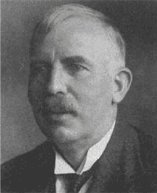
Ernest Rutherford 1871-1937
Ever since Rutherford, at the beginning of the century, began his amous experiments by firing alpha particles at thin gold foils, and along with Bohr, created our new ideas of the Atom, this method has been evolv-
ing in the building of ever larger accelerators, withever increasing energy. In this we have been asking nature questions and she has been replying to us. - In turn we have had to use the discipline of mathematics to understand the answers. This has been relatively successful but none the less critic on this method has appeared in the form of meta-
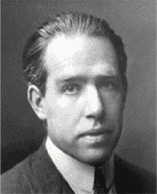
Niels H. D. Bohr 1885-1963
phors which suggest that this is like someone taking a sledge hammer and with it, granulating grandpas watch, then getting someone, who has never seen a watch, to investigate the fragments and ask him to tell what they
once were and how they worked together. The critic is connected to doubts about our interpre-
Ap10 P-I · Part #1. #10
tation and understanding of natures answers.
The Ghost in the Machine
The physicists have pointed out that Nature does not deceive us in her replies and that mathematics are a language which does not permit delusions. On the other hand the minds of Man are quite often caught being delusioned. However, a problem is still associated with our understanding of the replies of nature in the symbolism of mathematics and in spit of the unquestionable and grandiose success of quantum physics, it is still, as Stephen Hawking has said "Basically a theory about something which we do not know and can not predict." Here the reference is to the fact that although we can control the outcome statistically, we do not
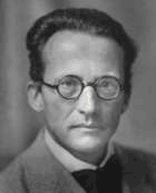
Erwin Schrödinger 1887-1961
know what is happening. Quantum mechanical investigation of the physical world have brought with it a ghost which has proven difficult to exorcise. This ghost has repeatedly reappeared and has caused many a physicist to sneer in disgust when ever it has been mentioned. The ghost is in the form of the demand for the observer, the scientific investigator, Man himself, be included in the outcome of the experiment. Even that he be included in the mathematical equations of quantum mechanics. Here enters one of the most famous of all physics thought experiments, that of the cat in the box by Erwin Schrödinger. A metaphor whose focal questions are till open for debate in science, but whose solution is nowhere in sight.