Sc51 P-2 · Part #2. #51
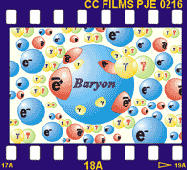
being sucked into the "empty little black holes" of virtual spatial particles in the early stages of the Baryon mass charging just after the peak of the Inflationary Era . The later two graphics show the end stage of this process of nucleon creation. In the QF-Venn Diagram Set presentations it can bee seen how the three quarks come .
into being. As this incredible insight gradually becomes conscious and so does the beauty of the process.
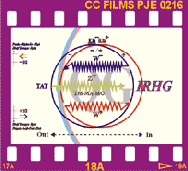
This is also described as mass charging of the spatial hadron gravitons, which are also called X-Bosons , or Primordial Black Holes . This is the creation process of the Weak and the Strong Nuclear Forces in the nucleons. The questions for the creation of None-Baryonic Dark- Matter at this stage are also being discussed.
Sc52 P-2 · Part #2. #52
Chapter VII :
The Seventh Division; "The End of the First Second of Creation"
Chapter Seven covers the Seventh Division of the QF-First Second of Creation and contains the Nineteenth-Twentieth Frames, the last of the QF-Film Slide Frames. The chapter
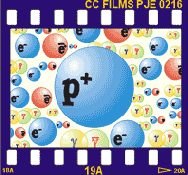
covers the end of the First Second of Creation and the end-stage in the creation of the Universes primary matter particles, the Baryon Hadrons: The Protons, the Permanently Stable Baryons and the Neutrons, the Unstable Baryon . The oddity in the progression of the QF-Venn diagrams from the First Frame in the QF-Special Singularity is that in the end of the First Second of Creation it produces the Three Quark Baryons . This gives the QF-theorisations on of its many credibility boosts. Finally a brief discussion of the decay of the Neutron is here included. The QF-Venn diagrams for the Baryons are then compared for confirmation to reality and the findings of experimental physics, this through known -
spin, or Parity Helicity of the matter Proton and Neutron.
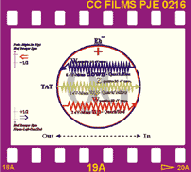
The two QF-Venn Diagrams show the completed creation of the "permanently stable" Proton
Sc53 P-2 · Part #2. #53
nucleon, but the chapter also show the same for the completed creation of the "slightly over-charged" unstable Neutron in which the "charge wave" (Z-negative) is waving "OUT" . The description of the nucleon creation also shows why the nucleons are, of the size we find them.
Part II is concluded with a brief account of the evolution of the Universe.
This begins with a wide angle SCSC fish-eye view of the Universes ingredients at the end of the First Second of Creation and is followed by short notes on: After the First Second until about 3,000 Years, then from 3.000 until
300.000 Years after the First Second. Next about 300/500.000 until 700.000 Years after Creation, followed by about 200.000.000 Years after the First Second and about 5.000.000.000 Years after Big Banguntil 10.000.000.000 ago now, 2000 AD. The final phase of approximately 10.000.000.000 Years after the Big Banguntil 5.000.000.000 ago now, 2001 AD and finally the Universe now, 2001 AD, or about 15.000.000.000 Years (+/- 3.000.000.000) after the Big Bang, or
5 x 10¹⁷ Seconds after the First Second
For commentary, contact . peace@peace-files.com
Sc54 P-3 · Part #3. #54


Part Three contains 22 Pages (54-76) in 7 chapters analyzing the QF-events during the First Second of Creation and the fundamental symmetries/reality of the Universe. This is connected to and compares very favorably to the Standard Model and the unsolved riddles of Physics. Last 3 chapters connect to Life , Consciousness and Brain. This Part desccribes Initial Conclutions of The Little Scrolls
Sc55 P-3 · Part #3. #55
Chapter I :
The Creation Visions Initial Assessment
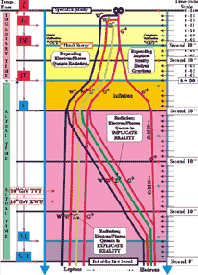
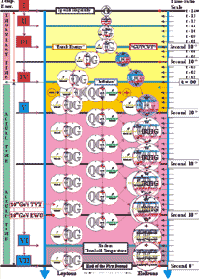
This chapter begins by a recount of the author's initial reaction to his Spiritual Experience Visions of Creation and his awareness of the possibilities it offered for answers to some fundamental riddles. Next it considers the questions applying to an initial assessments of the QF-Venn diagrams which then are projected through two graphical analyses of the First Second. First; the QF-Graphical First Second Continuum for the overview of the distribution progression for radiation and spatial quantification. Second; the QF-Graphical First Second Continuum overview of the interactions of matter-antimatter and spatial quanta symmetries is presented. This is the simplistic overview of the creation process showing how the symetries ruptures and thus creates the four forces of nature, plus the very subtle fith force of life.
Sc56 P-3 · Part #3. #56
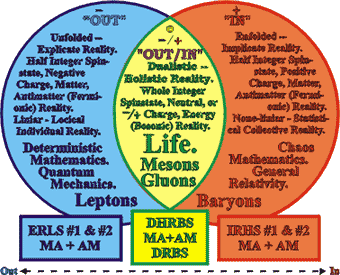
This is the QF-answer to the question of the unification of the four forces of Nature, showing that these forces are different manifestations of the same force. Their separation is tackled in the form of the rupture of their basic unification symmetries and the questions of Natures basic particle/wave symmetries are answered. This leads to one of the most important questions of all: What is the Fundamental Reality of Nature? This in turn is answered by the QF-theorisations in the form of a QF-Venn diagram. Here it is suggested that this will be the fundament for the answering of all questions on the composition of the Universe, its particle properties and symmetries, Life and Consciousness . This includes analyses of the QF-Fundamental Reality Symmetry and the Exclusion Principle.
On the next page is the QF-Theorys graphical presentation of the compositioon of the fundamental reality of nature, the Quantum Reality.
Sc57 P-3 · Part #3. #57
Sc58 P-3 · Part #3. #58
Chapter II : The QF-Models and the Force of Gravity
In this chapter the questions of the string-field nature of the QF-models is being scrutinized in analyses of indirect observations of elementary particles and the analyses of accelerator collisions. Further in the dual electron ground states and dumb-bell electrons, as well as the probability distributions for electron location in different energy-states of the hydrogen atom The inclusion of the Superstring models into the QF-Venn diagram is analyzed with simple sam-
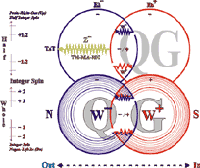
ples of Superstrings and their interactions. This is extended to a comparison of the M-Superstring concepts for the Baryons to the QF-Models V-Superstring Concept for the Leptons. Then the six dimensions of the QF- Superstrings are discussed along with their length, the spin-characteristics of the QF-Superstrings and the electric charge-mass of the QF-Superstrings. This is followed by the QF-solution to the questions of the unification of Quantum Mechanic s and General Relativity in the analyses of the QF-Superstring W-wave Gravitons and their extension into the corresponding V-poles of space, or the Dual Polar Virtual Energy of Space.
Sc59 P-3 · Part #3. #59
In this chapter the riddle of the connection between matter and space is solved with the method of the QF-Venn diagram set-mathematics, which does not work with any quantities or magnitudes. This pro- tects the method from getting lost in mathematical infinities and absurdities, which have until now prevented conventional mathematics from connecting Quantum Mechanics and General Relativity. With the QF-method the very nature of the interactions between matter and space and that is what is being sought. Einstein had acknowledged that the equations of General Relativity showed how space told matter where to go, but that they failed to show how matter achieved the curvature command in space. What was
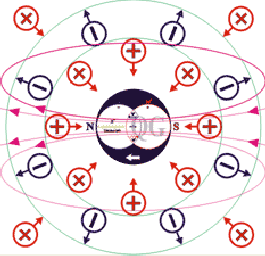
it that brought about the matter tells space how to be as John Wheeler so eloquently put it.
Sc60 P-3 · Part #3. #60

Chapter III : The QF-Model v/ Standard Model
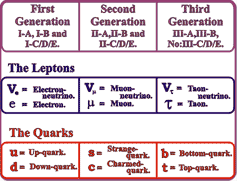
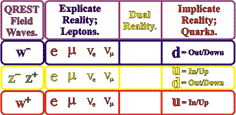
This chapter manages the questions of the QF-connections to the Standard Model of Physics. Here the fermions in the classification of matter/antimatter particles of the Standard Model are compared to the QF-model: The Permanent Leptons, the Temporary Leptons, the Hadron Components, the Baryons I (Chocolate Flavoured Quarks), the Baryons II (Vanilla Flavoured Quarks).
Baryons III (Strawberry Flavoured Quarks). This is then extended into the Bosons, or the force carriers, or interaction particles in the classification of matter/antimatter particles of the Standard Model which are here being compared to the QF-model.
The QF-Classification of fundamental particles of matter is taken to unseparable, not independently existing components, that make up the matter particles.