Ap91 P-3 · Part #3. #91
mand respect and awe. . . . There is a sense of urgency about it; the power is volcanic, pent up, ready to be unleashed." Science writer David Peat describes "a remarkable feeling of intensity that seems to flood the whole world around us with meaning. . . . We sense that we are touching something universal and perhaps eternal, so that the particular moment in time takes on a numinous character and seems to expand in time without limit. We sense that all boundaries between ourselves and the outer world vanish, for what we are experiencing lies beyond all categories and all attempts to be captured in logical thought." The language used to describe these experiences usually reflects the culture of the individual concerned. Western mystics tend to emphasize the personal quality of the presence, often describing themselves as being with someone, usually God, who is different from themselves but with whom a deep bond is felt. There is, of course, a long tradition of such religious experiences in the Christian Church and among the other Western religions. Eastern mystics emphasize the wholeness of existence and tend to identify themselves more closely with the presence. Writer Ken Wilber describes the Eastern mystical experience in characteristically cryptic language:
In the mystical consciousness, Reality is apprehended directly and immediately, meaning without any mediation, any symbolic elaboration, any conceptualization, or any abstractions; subject and object become one in a timeless and space less act that
Ap92 P-3 · Part #3. #92
is beyond any and all forms of mediation. Mystics universally speak of contacting reality in its "suchness", its "isness", its "thatness", without any intermediaries; beyond words, symbols, names, thoughts, images.
The essence of the mystical experience, then, is a type of shortcut to truth, a direct and unmediated contact with a perceived ultimate reality. According to Rudy Rucker:
The central teaching of mysticism is this: Reality is One. The practice of mysticism consists in finding ways to experience this unity directly. The One has variously been called the Good, God, the Cosmos, the Mind, the Void, or (perhaps most neutrally) the Absolute. No door in the labyrinthine castle of science opens directly onto the Absolute. But if one understands the maze well enough, it is possible to jump out of the system and experience the Absolute for oneself. . . . But, ultimately, mystical knowledge is attained all at once or not at all. There is no gradual path. . . .
In chapter 6 I described how some scientists and mathematicians claim to have had sudden revelatory insights akin to such mystical experiences. Roger Penrose describes mathematical inspirations as a sudden "breaking through" into a Platonic realm. Rucker reports that Kurt Gödel also spoke of the "other relation to reality," by which he could directly perceive mathematical objects, such as infinity. Gödel himself was apparently able to achieve this by
Ap93 P-3 · Part #3. #93
adopting meditative practices, such as closing off the other senses and lying down in a quiet place.For other scientists the revelatory experience happens spontaneously, in the midst of the daily clamour. Fred Hoyle relates such an incident that occurred to him while he was driving through the North of England. "Rather as the revelation occurred to Paul on the Road to Damascus mine occurred on the road over Bowes Moor." Hoyle and his collaborator Jayant Narlikar had, in the late 1960s, been working on a cosmological theory of electromagnetism that involved some daunting mathematics. One day, as they were struggling over a particularly complicated integral, Hoyle decided to take a vacation from Cambridge to join some colleagues hiking in the Scottish Highlands.
As the miles slipped by I turned the quantum mechanical problem . . . over in my mind, in the hazy way I normally have in thinking mathematics in my head. Normally, I have to write things down on paper, and then fiddle with the equations and integrals as best I can. But somewhere on Bowes Moor my awareness of the mathematics clarifed, not a little, not even a lot, but as if a huge brilliant light had suddenly been switched on. How long did it take to become totally convinced that the problem was solved? Less than five seconds. It only remained to make sure that before the clarity faded I had enough of the essential steps stored safely in my recallable memory. It is indicative of the measure of certainty I felt that in the ensuing days I didn't trouble to
Ap94 P-3 · Part #3. #94
to paper. When ten days or so later I returned to Cambridge I found it possible to write out the thing without difficulty.
Hoyle also reports a conversation on the topic of revelation with Richard Feynman:
Some years ago I had a graphic description from Dick Feynman of what a moment of inspiration feels like, and of it being followed by an enormous sense of euphoria, lasting for maybe two or three days. I asked how often had it happened, to which Feynman replied `four', at which we both agreed that twelve days of euphoria was not a great reward for a lifetime's work.
I have recounted Hoyle's experience here rather than in chapter 6 because he himself describes it as a truly religious (as opposed to a merely Platonic) event. Hoyle believes that the organization of the cosmos is controlled by a "superintelligence" who guides its evolution through quantum processes, an idea I mentioned briefly in
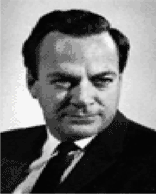
Richard Feineman 1918-1988
chapter? Furthermore, Hoyle's is a teleological God (somewhat like that of Aristotle or Teilhard de Chardin) directing the world toward a final state in the infnite future. Hoyle believes that by acting at the quantum level this superintelligence can implant thoughts or
Ap95 P-3 · Part #3. #95
In our quest for ultimate answers it is hard not to be drawn, in one way or another, to the infinite. Whether it is an infinite tower of turtles, an infinity of parallel worlds, an infinite set of mathematical propositions, or an infinite Creator, physical existence surely cannot be rooted in anything finite. Western religions have a long tradition of identifying God with the Infinite, whereas Eastern philosophy seeks to eliminate the differences between the One and the Many, and to identify the Void and the Infinite--zero and infinity. When the early Christian thinkers such as Plotinus proclaimed that God is infinite, they were primarily concerned to demonstrate that he is not limited in any way. The mathematical concept of infinity was at that time still fairly vague. It was generally believed that infinity is a limit toward which an enumeration may proceed, but which is unachievable in reality. Even Aquinas, who conceded God's infinite nature, was not prepared to accept that infinity had more than a potential, as opposed to an actual, existence. An omnipotent God "cannot make an absolutely unlimited thing," he maintained. The belief that infinity was paradoxical and self-contradictory persisted until the nineteenth century. At this stage the mathematician Georg Cantor, while investigating problems of trigonometry, finally succeeded in providing a rigorous logical demonstration of the selfconsistency of the actually infinite. Cantor had a rough ride with his peers, and was dismissed by some eminent mathematicians as a madman. In fact, he did suffer mental illness.
Ap96 P-3 · Part #3. #96
But eventually the rules for the consistent manipulation of infinite numbers, though often strange and counterintuitive, came to be accepted. Indeed, much of twentieth-century mathematics is founded on the concept of the infinite (or infinitesimal). If infinity can be grasped and manipulated using rational thought, does this open the way to an understanding of the ultimate explanation of things without the need for mysticism? No, it doesn't. To see why, we must take a look at the concept of infinity more closely. One of the surprises of Cantor's work is that there is not just one infinity but a multiplicity of them. For example, the set of all integers and the set of all fractions are both infinite sets. One feels intuitively that there are more fractions than integers, but this is not so. On the other hand, the set of all decimals is bigger than the set of all fractions, or all integers. One can ask: is there a "biggest" infinity? Well, how about combining all infinite sets together into one superduperset? The class of all possible sets has been called Cantor's Absolute. There is one snag. This entity is not itself a set, for if it were it would by definition include itself. But self-referential sets run smack into Russell's paradox. And here we encounter once more the Gödelian limits to rational thought--he mystery at the end of the universe. We cannot know Cantor's Absolute, or any other Absolute, by rational means, for any Absolute, being a Unity and hence complete within itself, must include itself. As Rucker remarks in connection with the Mindscape--the class of all sets of ideas--If the Mindscape is a One, then it is a member of itself, and thus can only be known through a flash of mystical vision.
Ap97 P-3 · Part #3. #97
No rational thought is a member of itself, so no rational thought could tie the Mindscape into a One."
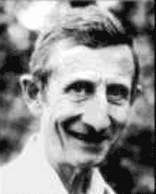
Freeman Dyson 1923-19??
Does the frank admission of hopelessness discussed in the previous section mean that all metaphysical reasoning is valueless? Should we adopt the approach of the pragmatic atheist who is content to take the universe as given, and get on with cataloguing its properties? There is no doubt that many scientists are opposed temperamentally to any form of meta physical, let alone mystical arguments. They are scornful of the notion that there might exist a
God, or even an impersonal creative principle or ground of being that would underpin reality and render its contingent aspects less starkly arbitrary. Personally I do not share their scorn. Although many metaphysical and theistic theories seem contrived or childish, they are not
Ap98 P-3 · Part #3. #98
obviously more absurd than the belief that the universe exists, and exists in the form it does, reasonlessly. It seems at least worth trying to construct a metaphysical theory that reduces some of the arbitrariness of the world. But in the end a rational explanation for the world in the sense of a closed and complete system of logical truths is almost certainly impossible. We are barred from ultimate knowledge, from ultimate explanation, by the very rules of reasoning that prompt us to seek such an explanation in the first place. If we wish to obviously more absurd than the belief that the universe exists, and exists in the form it does, reasonlessly. It seems at least worth trying to construct a metaphysical theory that reduces some of the arbitrariness of the world. But in the end a rational explanation for the world in the sense of a closed and complete system of logical truths is almost certainly impossible. We are barred from ultimate knowledge, from ultimate explanation, by the very rules of reasoning that prompt us to seek such an explanation in the first place. If we wish to progress beyond, we have to embrace a different concept of "understanding" from that of rational explanation. Possibly the mystical path is a way to such an understanding. I have never had a mystical experience myself, but I keep an open mind about the value of such experiences. Maybe they provide the only route beyond the limits to which science and philosophy can take us, the only possible path to the Ultimate. The central theme that I have explored in this book is that, through science, we human beings are able to grasp at least some of nature's secrets. We have cracked part of the
Ap99 P-3 · Part #3. #99
cosmic code. Why this should be, just why Homo sapiens should carry the spark of rationality that provides the key to the universe, is a deep enigma. We, who are children of the universe--animated stardust--can nevertheless reflect on the nature of that same universe, even to the extent of glimpsing the rules on which it runs. How we have become linked into this cosmic dimension is a mystery. Yet the linkage cannot be denied. What does it mean? What is Man that we might be party to such privilege? I cannot believe that our existence in this universe is a mere quirk of fate, an accident of history, an incidental blip in the great cosmic drama. Our involvement is too intimate. The physical species Homo may count for nothing, but the existence of mind in some organism on some planet in the universe is surely a fact of fundamental significance. Through conscious beings the universe has generated self-awareness. This can be no trivial detail, no minor by-product of mindless, purposeless forces. We are truly meant to be here.
End of Extract.
"The finest emotion of which we are capable is the mystic emotion. Herein lies the germ of all art and all true science. Anyone to whom this feeling is alien, who is no longer capable of wonderment and lives in a state of fear is a dead man. "
For commentary, contact . peace@peace-files.org
Albert Einstein
Ap100 P-3 · Part #3. #100
This has been a very brief description of the alternative mathematical method for solving the final riddles of physics and neurology. A solution that has been achieved through a mystical experience, such as is being described in the extract from Paul Daviess book. The more amazing and suspicious aspect of the creation of the Six Dimensional QF-CUT/TOE Paradigm is of course in the claimed relationship to the prophesy in The Book of Revelation , where the connection is being made directly to the 5th and 10th chapters. The presentation of the paradigm in The Little Scroll , however, is being approached from a science viewpoint and without entering into any religious spiritual doctrines. That connection is being dealt with in The Revelation Files , where it is explained in some detail. Full details are then found in the book: The Autobiography of Mr. 666 , where the interpretations are NOT being approached from a religious viewpoint.
For commentary, contact . peace@peace-files.org
To Airmail Shiping Prices Page
To Surface Shiping Prices Page